
Updated: May 14, 2026
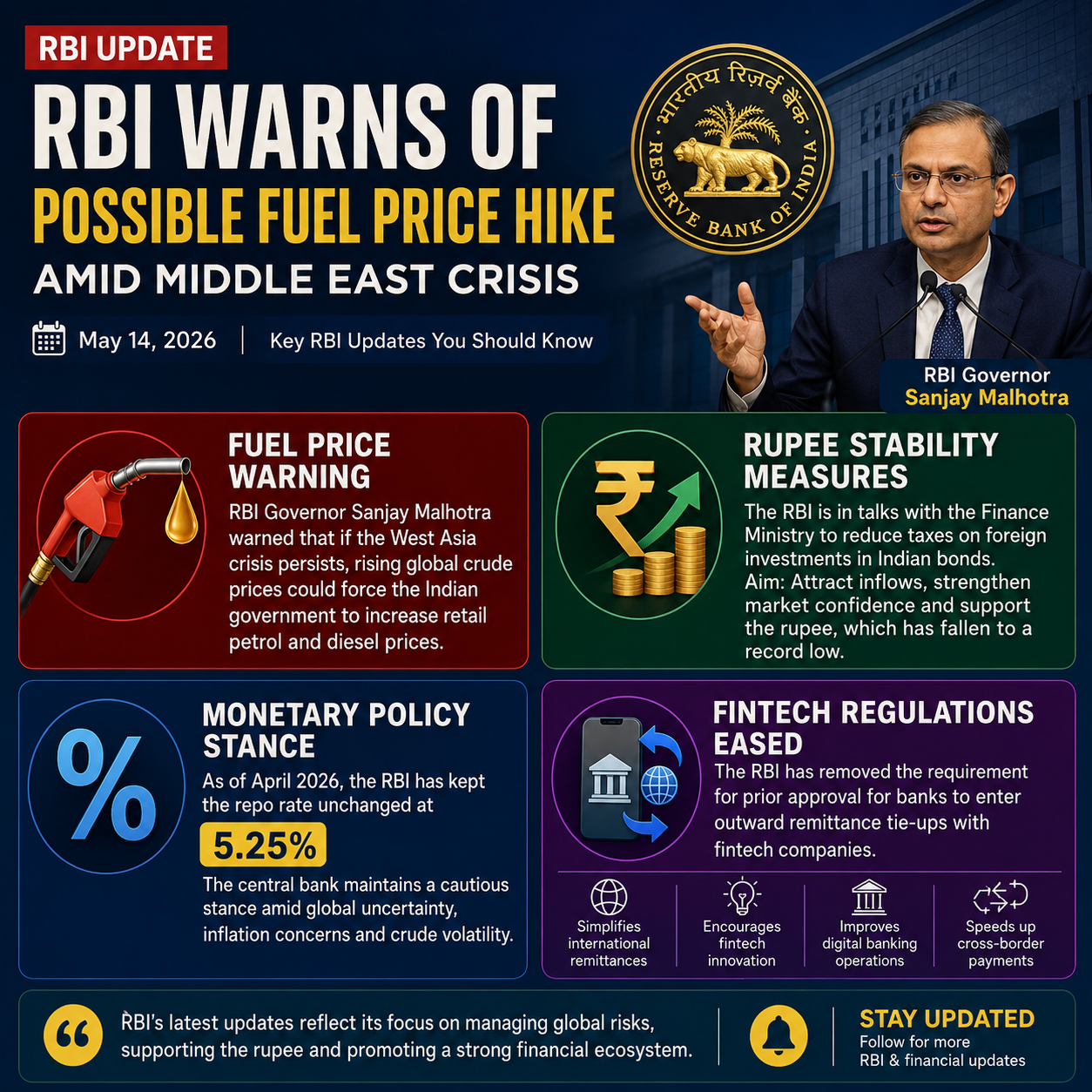
The Reserve Bank of India (RBI) has issued important economic updates regarding fuel prices, rupee stability, foreign investments, and fintech regulations. RBI Governor Sanjay Malhotra stated that the ongoing conflict in West Asia (Middle East) is creating pressure on global crude oil prices, which may directly impact India’s fuel prices and overall economy.
RBI Warns of Possible Petrol & Diesel Price Hike
According to RBI Governor Sanjay Malhotra, if the Middle East conflict continues for a longer period, rising international crude oil prices could force the Indian government to increase domestic petrol and diesel prices.
India imports a large portion of its crude oil requirements, and any sharp increase in global oil prices can impact:
- Petrol and diesel prices
- Inflation rates
- Transportation costs
- Daily household expenses
- Overall economic growth
The RBI stated that fuel price management will become important to maintain economic stability in the coming months.
RBI Plans Measures to Support the Indian Rupee
The Indian rupee has recently witnessed pressure against the US dollar, touching record low levels. To stabilize the currency and attract foreign investments, the RBI is reportedly in discussions with the Finance Ministry.
Key Proposal:
The RBI has recommended reducing taxes on foreign investments in Indian government bonds.
This move aims to:
- Increase foreign investment inflows
- Improve market confidence
- Strengthen the Indian rupee
- Support financial market stability
Experts believe that easier investment conditions could help bring more global investors into Indian debt markets.
RBI Keeps Repo Rate Unchanged at 5.25%
In its April 2026 monetary policy announcement, the RBI decided to keep the repo rate unchanged at 5.25%.
The central bank maintained its cautious stance considering:
- Global economic uncertainty
- Inflation concerns
- Rising geopolitical tensions
- Volatile crude oil prices
The unchanged repo rate is intended to balance inflation control and economic growth.
RBI Eases Fintech & Banking Regulations
In another important update, the RBI has removed the requirement for banks to seek prior approval before entering outward remittance partnerships with fintech companies.
This decision is expected to:
- Simplify international money transfer services
- Encourage fintech innovation
- Improve digital banking operations
- Speed up cross-border payment solutions
The move is seen as a positive step toward strengthening India’s digital financial ecosystem.
Conclusion
The latest RBI updates highlight growing concerns over global economic uncertainty and its impact on India. Rising crude oil prices, pressure on the rupee, and changing financial regulations are expected to play a major role in India’s economic landscape in 2026.


