
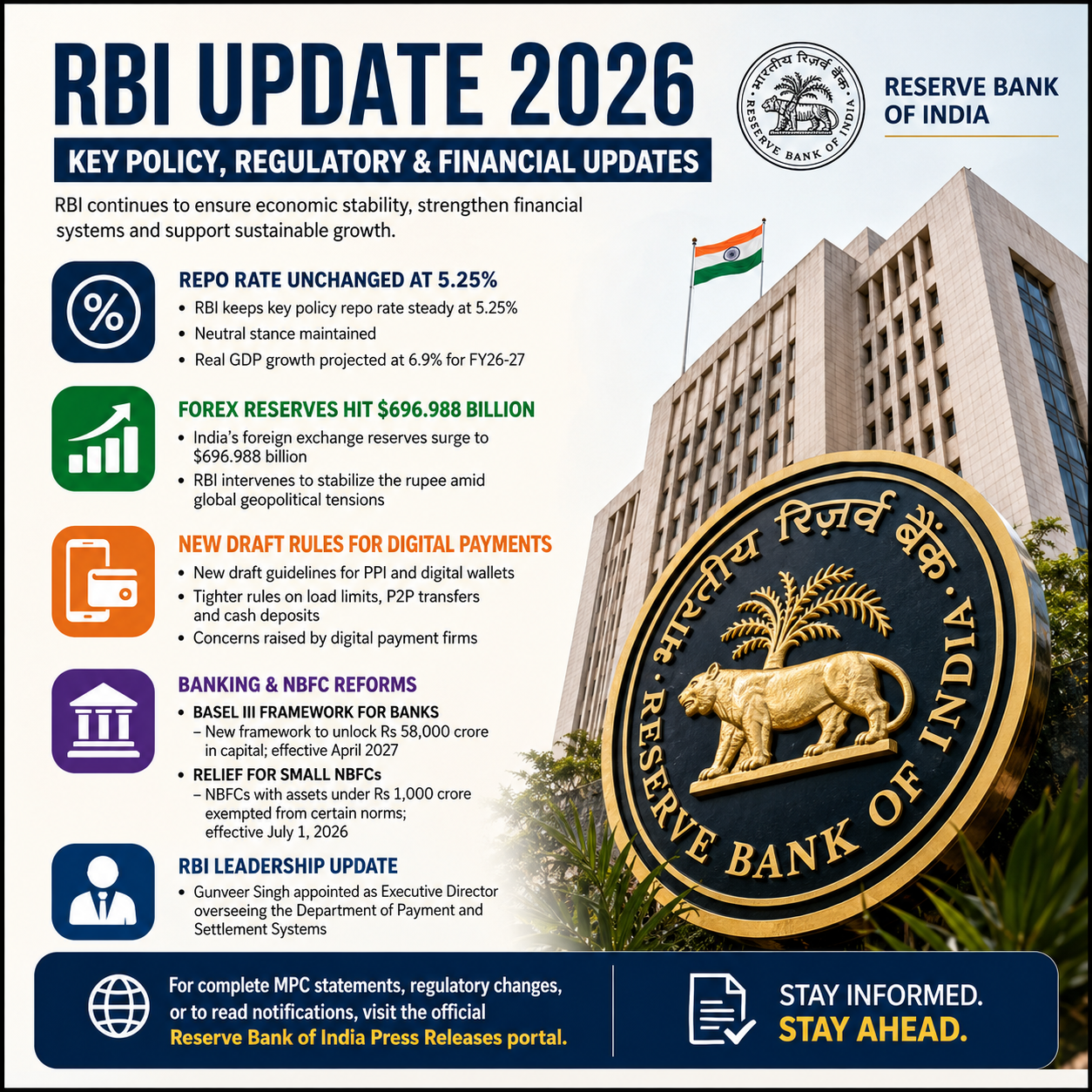
The Reserve Bank of India (RBI) has announced key monetary and regulatory updates aimed at maintaining economic stability, strengthening the banking sector, and supporting the Indian rupee amid global uncertainties.
With rising geopolitical tensions, fluctuating crude oil prices, and evolving digital payment regulations, the RBI continues to take proactive measures to ensure financial stability and sustainable economic growth across the country.
RBI Keeps Repo Rate Steady at 5.25%
In its latest Monetary Policy Committee (MPC) meeting, the RBI decided to maintain the key repo rate at 5.25% while retaining a neutral policy stance.
The central bank stated that the decision was taken considering:
- Global geopolitical uncertainties
- Supply chain disruptions
- Volatile crude oil prices
- Inflation management priorities
The RBI has projected India’s real GDP growth for FY 2026-27 at 6.9%, reflecting confidence in the country’s economic momentum despite global challenges.
RBI Intervenes to Stabilize the Rupee
The RBI is actively monitoring the foreign exchange market to prevent excessive volatility in the Indian rupee.
India’s foreign exchange reserves recently surged to an impressive $696.988 billion, providing strong support for currency stability and external economic resilience.
Due to ongoing tensions in the Middle East and global market pressure, the RBI may consider additional policy measures, including possible rate adjustments, if required to stabilize the rupee and manage inflationary risks.
New RBI Draft Rules for Digital Payments & Wallets
The RBI has released fresh draft guidelines for Prepaid Payment Instruments (PPI) and digital wallets to improve transparency and security in digital transactions.
The proposed changes include:
- Stricter wallet loading limits
- Caps on peer-to-peer (P2P) transfers
- Tighter rules for cash deposits
- Enhanced compliance requirements for payment companies
These proposed norms have raised concerns among several digital payment firms and fintech companies, which believe the tighter regulations may impact user convenience and operational flexibility.
Major Banking & NBFC Regulatory Reforms
Basel III Framework for Banks
The RBI has introduced a revised Basel III framework, expected to unlock nearly Rs 58,000 crore in additional capital for Indian banks.
The framework is scheduled to come into effect from April 2027 and is aimed at:
- Strengthening banking sector resilience
- Improving capital efficiency
- Supporting future credit growth
Relief for Small NBFCs
In another significant move, the RBI announced regulatory relaxations for small non-deposit-taking NBFCs with assets below Rs 1,000 crore.
Effective from July 1, 2026, these NBFCs will receive exemptions from certain:
- Registration requirements
- Reserve fund compliance norms
The move is expected to reduce compliance burdens and support smaller financial institutions.
RBI Leadership Update
The RBI has appointed Gunveer Singh as the new Executive Director, where he will oversee the Department of Payment and Settlement Systems.
His appointment comes at a crucial time as India’s digital payments ecosystem continues to expand rapidly.
Conclusion
The latest RBI updates highlight the central bank’s balanced approach toward maintaining inflation control, protecting the rupee, strengthening banking regulations, and supporting digital financial infrastructure.
As India navigates global economic uncertainties, the RBI’s policy decisions will continue to play a critical role in sustaining economic growth and financial stability.
For official notifications, policy statements, and regulatory announcements, users can visit the official Reserve Bank of India Press Releases portal.


