
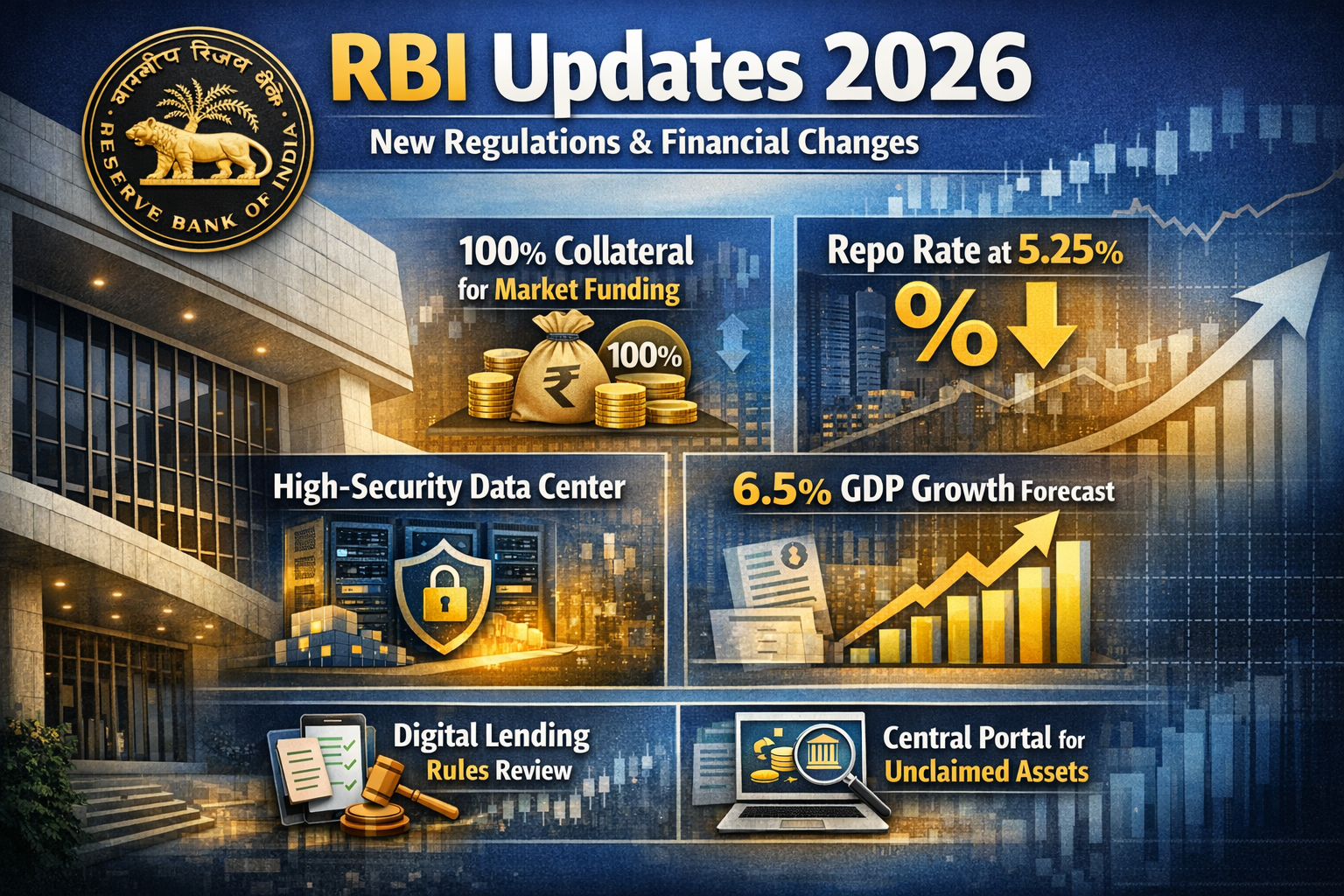
The Reserve Bank of India (RBI) has introduced several important regulatory and monetary policy updates in early 2026 aimed at strengthening India’s financial system, improving market discipline, and ensuring economic stability.
After implementing multiple rate cuts in 2025 to support growth, the RBI is now focusing on liquidity management, capital market risk control, digital security, and regulatory oversight.
Here is a detailed overview of the latest RBI updates for 2026.
1. 100% Collateral Requirement for Capital Market Funding (Effective April 1, 2026)
In a major regulatory move, the RBI has mandated that banks must ensure full collateralization of credit extended to capital market participants.
Key Highlights:
All loans to brokers, clearing members, and other intermediaries must be 100% secured.
Under the Margin Trading Facility (MTF):
Financing must be fully backed by collateral.
At least 50% of the collateral must be in cash or cash equivalents.
Objective of This Rule:
Reduce systemic risk in capital markets
Prevent excessive leverage
Strengthen financial discipline
Protect the banking sector from speculative exposure
This move enhances transparency and ensures greater stability in the financial ecosystem.
2. High-Security Data Center in Bhubaneswar
To enhance cybersecurity and operational resilience, the RBI has established a high-security data center in Bhubaneswar, Odisha.
Purpose:
Protect critical financial data
Support payment and settlement systems
Ensure uninterrupted banking operations
Provide disaster recovery and backup support
With increasing digital transactions and cyber threats, this initiative strengthens India’s financial infrastructure and safeguards banking systems.
Monetary Policy Updates (Based on 2025 Decisions)
3. Repo Rate Reduced to 5.25%
During 2025, the RBI followed an easing cycle to support economic growth.
Repo Rate Changes:
June 2025: 50 basis points (bps) cut
December 2025: Reduced further to 5.25%
Total rate reduction in 2025: 125 bps
Impact:
Lower home loan and business loan interest rates
Boost in credit demand
Support to economic recovery
4. Cash Reserve Ratio (CRR) Reduced to 3%
In June 2025, the RBI reduced the CRR by 100 basis points.
New CRR: 3%
Purpose:
Increase liquidity in the banking system
Enhance lending capacity of banks
Support economic growth
5. GDP Growth Projection for FY26
The RBI has projected 6.5% real GDP growth for FY26, indicating confidence in India’s economic momentum.
The projection is supported by:
Stable domestic consumption
Government infrastructure spending
Controlled inflation
Strong financial sector performance
Regulatory & Financial Sector Developments (2026)
6. Digital Lending Framework Under Review
The RBI is reviewing digital lending practices, especially for NBFCs.
Focus areas include:
Staff accountability
Compliance standards
Consumer protection
Liability in case of negligence
The aim is to strengthen governance and ensure transparent digital lending practices.
7. Proposal for Central Portal for Unclaimed Assets
A proposal is under review for creating a centralized portal to help individuals track:
Unclaimed financial assets
Dormant bank accounts
If implemented, it will improve transparency and help citizens recover unclaimed funds more easily.
Conclusion
The RBI’s latest updates for 2026 show a balanced approach toward financial stability and economic growth.
While 2025 focused on monetary easing through repo rate and CRR reductions, 2026 emphasizes:
Stronger capital market regulations
Tighter liquidity monitoring
Improved digital security
Enhanced consumer protection
These measures are expected to strengthen investor confidence, reduce financial risk, and maintain long-term economic stability in India.


