
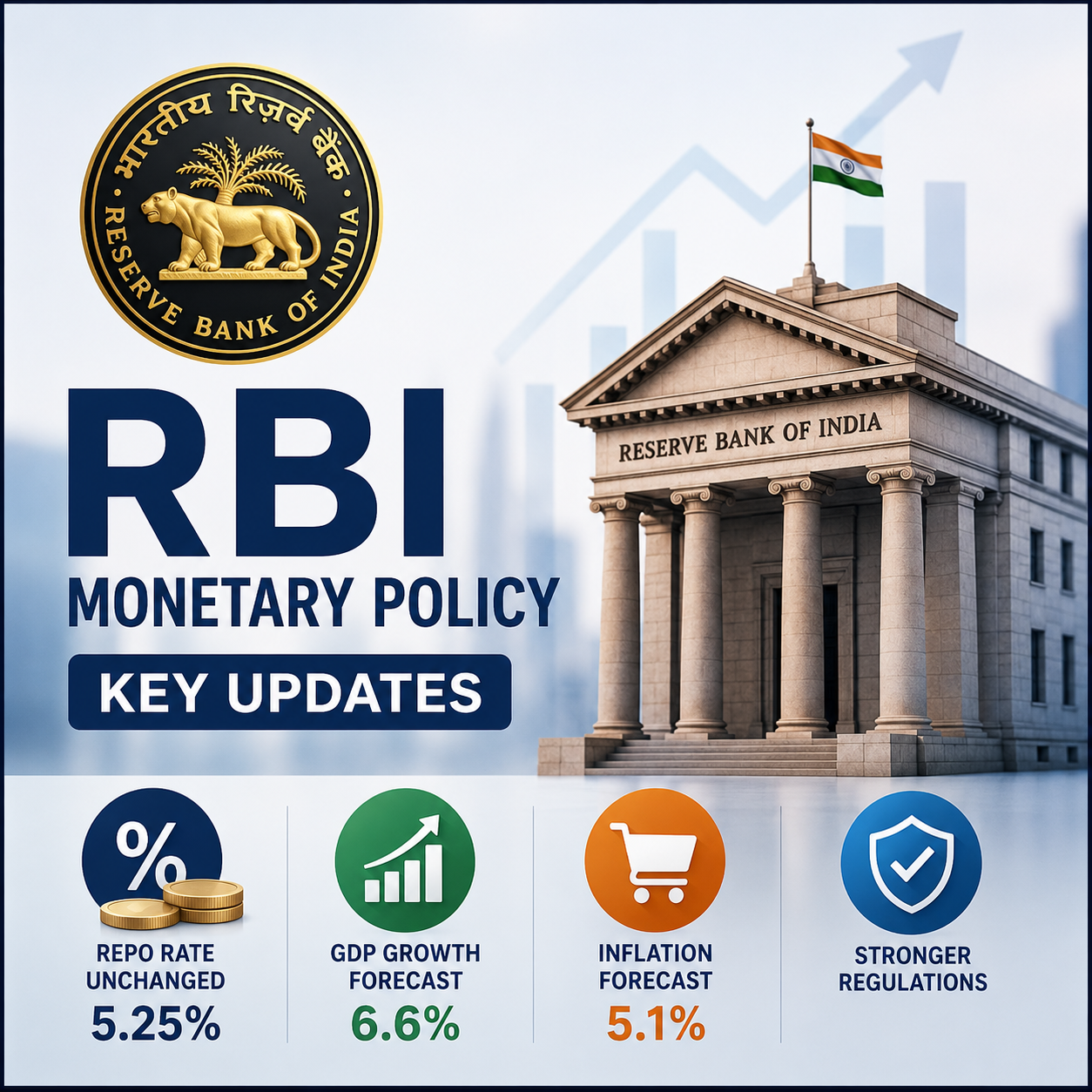
The Reserve Bank of India (RBI), through its Monetary Policy Committee (MPC), has decided to maintain the repo rate at 5.25% while continuing with a neutral policy stance. Alongside the rate decision, the RBI revised its economic growth projections, updated inflation expectations, announced measures to support the Indian rupee, and introduced several regulatory actions affecting banks and NBFCs.
This policy review highlights the RBI’s focus on balancing economic growth, inflation management, and financial stability amid evolving global economic conditions.
RBI Maintains Key Policy Rates
The Monetary Policy Committee unanimously voted to keep the benchmark policy rates unchanged.
Current RBI Policy Rates
| Policy Instrument | Rate |
|---|---|
| Repo Rate | 5.25% |
| Standing Deposit Facility (SDF) | 5.00% |
| Marginal Standing Facility (MSF) | 5.50% |
| Bank Rate | 5.50% |
By maintaining the repo rate, the RBI aims to carefully monitor inflation trends while ensuring adequate support for economic growth.
RBI Revises GDP Growth and Inflation Projections
The central bank adjusted its economic outlook for the current financial year.
GDP Growth Forecast
The RBI lowered its real GDP growth projection to 6.6%, compared to the earlier estimate of 6.9%. The revision reflects concerns regarding global economic uncertainties, external demand conditions, and financial market volatility.
Inflation Outlook
The RBI increased its Consumer Price Index (CPI) inflation forecast to 5.1%. Rising global energy prices, supply-chain disruptions, and commodity price fluctuations remain major risks to inflation.
Economic Outlook Summary
- GDP Growth Forecast: 6.6%
- Previous GDP Estimate: 6.9%
- CPI Inflation Forecast: 5.1%
- Key Inflation Risks:
- Global energy price volatility
- Supply-chain disruptions
- Imported inflation pressures
RBI Measures to Support the Indian Rupee
With the Indian rupee experiencing pressure against major global currencies, the RBI announced several initiatives aimed at attracting foreign capital and improving forex liquidity.
Key Forex Measures
1. Enhanced FCNR Deposit Support
Banks have been provided greater flexibility to mobilize Foreign Currency Non-Resident (FCNR) deposits, encouraging overseas Indian investments.
2. Liquidity-Enhancing Swap Facilities
The RBI introduced special swap arrangements to improve foreign currency liquidity within the banking system.
3. Full Hedging Support
Authorized banks can now access comprehensive hedging support to manage foreign exchange risks associated with FCNR deposits.
These measures are expected to strengthen foreign exchange reserves and improve market confidence.
RBI Imposes Restrictions on Mogaveera Co-operative Bank
The RBI has placed operational restrictions on Mumbai-based Mogaveera Co-operative Bank due to concerns regarding its financial health.
Key Restrictions
- Withdrawal limit capped at ₹1 lakh per depositor
- Restrictions effective for six months
- Certain banking operations will remain under regulatory supervision
The move aims to protect depositors while allowing the bank time to improve its financial position.
RBI Cancels Registration of 135 NBFCs
In a significant regulatory action, the RBI canceled the Certificates of Registration (CoR) of 135 Non-Banking Financial Companies (NBFCs).
Reasons for Cancellation
- Non-compliance with RBI regulations
- Failure to maintain required financial standards
- Violation of operational guidelines
A large number of the affected NBFCs were registered in West Bengal.
This action reflects the RBI’s commitment to strengthening the financial sector and ensuring regulatory compliance.
RBI Proposes Stronger Governance Framework
To improve risk management and regulatory oversight, the RBI has proposed a comprehensive governance framework for all regulated entities.
Areas Covered Under the New Framework
Risk Management
Enhanced monitoring systems to identify and mitigate financial risks.
Compliance Functions
Stronger compliance mechanisms to ensure adherence to regulatory standards.
Internal Audit Systems
Independent and robust audit structures for improved transparency and accountability.
Governance Standards
Uniform governance practices across banks, NBFCs, cooperative banks, and other regulated institutions.
The framework aims to build a more resilient and transparent financial ecosystem.
What This Means for the Indian Economy
The RBI’s latest policy review reflects a cautious approach toward balancing growth and inflation. While keeping interest rates unchanged provides stability, revised growth and inflation forecasts indicate that global economic uncertainties continue to influence India’s economic outlook.
At the same time, regulatory actions against weak financial institutions and governance reforms demonstrate the RBI’s continued focus on strengthening the country’s banking and financial system.
Conclusion
The RBI’s decision to maintain the repo rate at 5.25%, revise GDP growth expectations to 6.6%, and increase inflation projections to 5.1% highlights its balanced policy approach. Additional measures to support the rupee, stricter oversight of banks and NBFCs, and governance reforms signal the central bank’s commitment to maintaining financial stability and sustainable economic growth.
As economic conditions evolve, businesses, investors, banking professionals, and financial institutions should closely monitor future RBI policy announcements and regulatory developments.


