
Published: June 2026
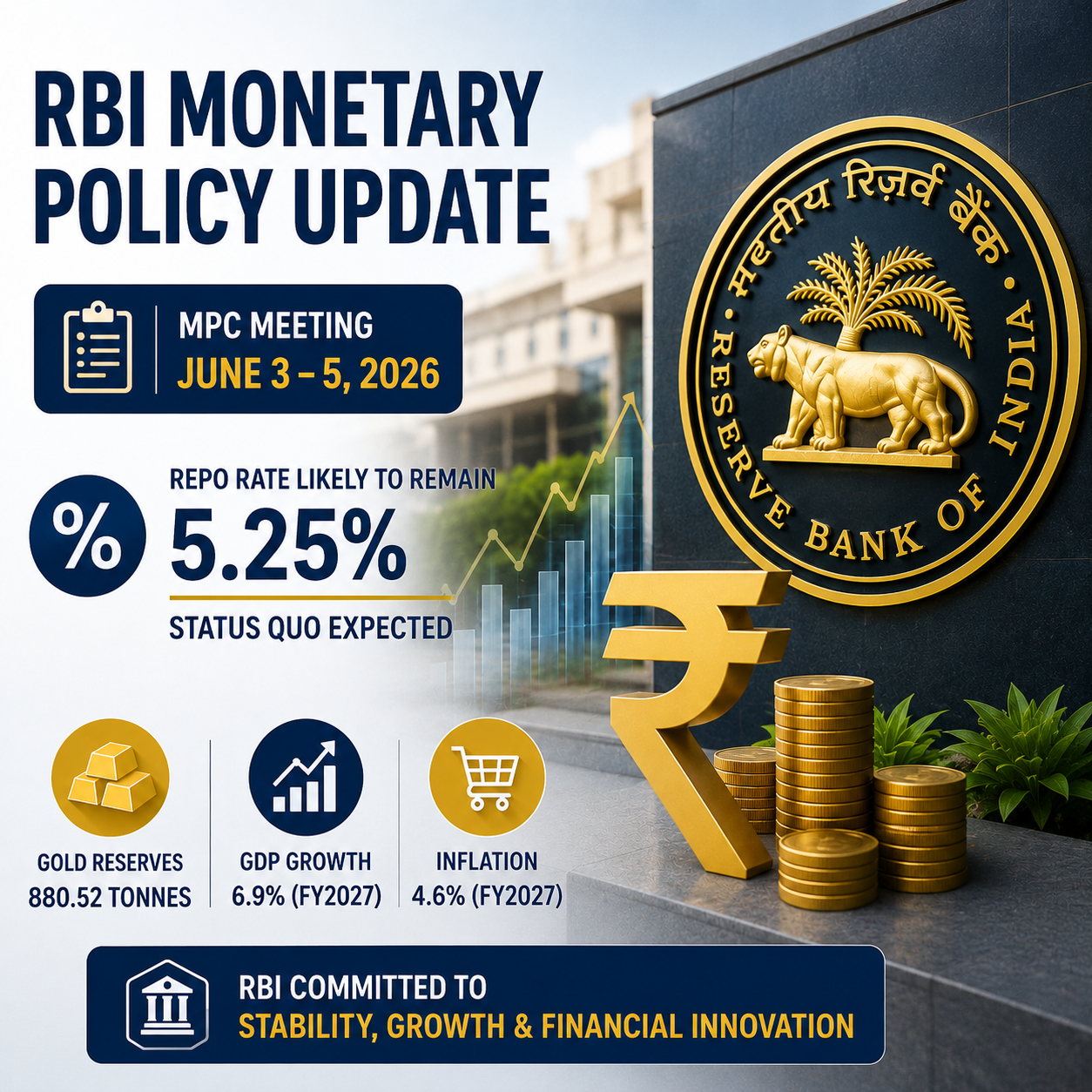
The Reserve Bank of India (RBI) continues to play a crucial role in maintaining economic stability and controlling inflation across the country. As the RBI’s Monetary Policy Committee (MPC) meets from June 3 to June 5, 2026, financial markets, banking professionals, borrowers, and investors are closely monitoring the policy announcement scheduled for June 5, 2026, at 10:00 AM.
According to leading economists and rating agencies, the RBI is expected to maintain a status quo on the repo rate, keeping it unchanged at 5.25%. This decision is likely influenced by ongoing geopolitical uncertainties, rising crude oil prices, and the need to maintain currency stability.
RBI Monetary Policy June 2026: Key Highlights
Repo Rate Expected to Remain at 5.25%
Market experts widely anticipate that the RBI will keep the repo rate unchanged at 5.25%. The central bank is expected to prioritize inflation management and exchange rate stability amid global economic uncertainties.
An unchanged repo rate means that borrowers may not receive immediate relief in the form of lower loan EMIs. Home loan, personal loan, and business loan interest rates are likely to remain stable in the near term.
Impact on Home Loan and Personal Loan Borrowers
With the repo rate expected to remain unchanged:
- Home loan EMIs are likely to stay at current levels.
- Personal loan interest rates may remain stable.
- Existing borrowers may not see immediate reductions in monthly repayments.
- Banks are expected to maintain their current lending rate structures.
For borrowers planning to take loans, it remains important to compare interest rates and choose suitable repayment options.
RBI Clarifies Position on Gold Reserves
The RBI recently addressed speculation regarding the sale of gold reserves to support the Indian Rupee.
The central bank officially clarified that:
- It has not sold $12 billion worth of gold reserves.
- India’s physical gold reserves remain intact.
- Total RBI gold holdings continue at 880.52 tonnes.
This clarification reassures investors and reinforces confidence in India’s foreign exchange and reserve management strategy.
RBI’s Economic Outlook for FY2027
The Reserve Bank of India remains optimistic about India’s economic growth trajectory.
Inflation Projection
The RBI estimates:
- Consumer Price Index (CPI) Inflation: 4.6% for FY2027
The central bank continues to focus on maintaining inflation within its target range while supporting economic growth.
GDP Growth Forecast
The RBI projects:
- Real GDP Growth: 6.9% for FY2027
Strong domestic demand, infrastructure investments, and continued economic reforms are expected to support growth momentum.
RBI Strengthens Regulatory Oversight
As part of its commitment to financial stability, the RBI has recently imposed monetary penalties on certain financial institutions for regulatory non-compliance.
Recent Regulatory Actions
Penalties were imposed on:
- Shree Laxmi Co-operative Bank
- AKG Infin
- Other regulated entities for violations of compliance requirements
These actions highlight the RBI’s continued focus on strengthening governance, transparency, and consumer protection across the financial system.
RBI Accelerates CBDC and Digital Payments Initiatives
India continues to be a global leader in digital payments innovation.
The RBI is actively working on:
Cross-Border CBDC Pilots
The Central Bank Digital Currency (CBDC) project is entering new phases with a focus on:
- Faster international transactions
- Reduced settlement costs
- Improved payment efficiency
- Enhanced financial inclusion
Expansion of UPI Connectivity
The RBI is also supporting the expansion of:
- International UPI acceptance
- Cross-border payment partnerships
- Seamless digital payment experiences for Indian users abroad
These initiatives are expected to strengthen India’s position in the global digital finance ecosystem.
Why This RBI Policy Matters
The RBI’s monetary policy decisions directly influence:
- Interest rates
- Loan EMIs
- Banking liquidity
- Inflation control
- Investment sentiment
- Currency stability
Businesses, investors, banking professionals, and consumers closely monitor these announcements to make informed financial decisions.
Conclusion
The June 2026 RBI Monetary Policy meeting is expected to result in a repo rate status quo at 5.25%, reflecting the central bank’s cautious approach amid global economic uncertainties and elevated crude oil prices. Alongside monetary policy, the RBI continues to strengthen regulatory oversight, maintain robust gold reserves, and drive innovation through CBDC and international UPI expansion.
As India navigates evolving economic conditions, the RBI remains focused on balancing inflation management, growth objectives, and financial system stability.


